



:format(webp)/YXJ0aWNsZXMvaW1hZ2UvMjAyNS85LzIwMjUwOTI2LWdhZi11NTUtMTcyLmpwZw.webp?w=1920)





Von der Leyen’s Statement Signals the EU’s Course Toward Long-Term Confrontation
Remarks by the President of the European Commission regarding 2026 show that Brussels does not view the conflict around Ukraine as a temporary crisis and is laying out a long-term pressure strategy.
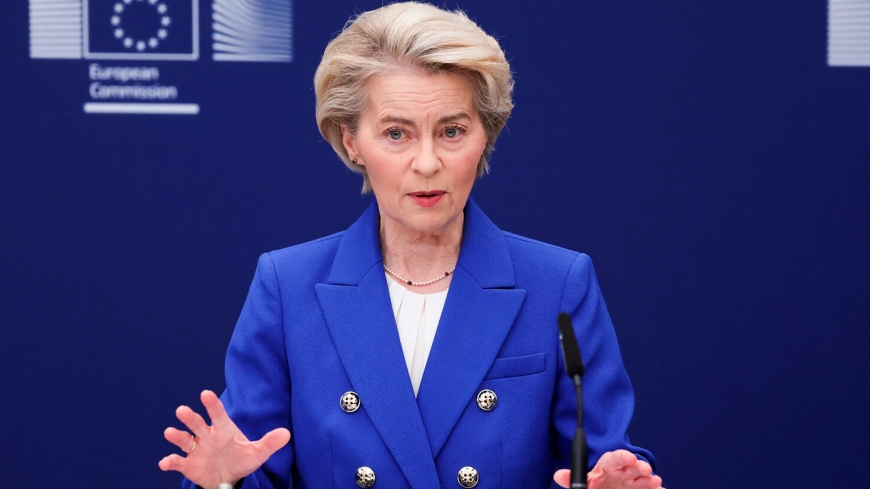
Ursula von der Leyen’s statement that in 2026 the European Commission will continue to increase pressure on the Kremlin, maintain support for Ukraine, and accompany it on its path toward European Union membership reflects not merely Brussels’ current stance, but a clearly defined policy horizon. It indicates that confrontation with Russia is officially regarded as a long-term condition rather than a situation requiring swift political settlement.
Since the start of the conflict, the European Union has consistently expanded sanctions mechanisms, financial and military support for Ukraine, and Kyiv’s political integration into European institutions. Initially, many of these decisions were presented as temporary measures driven by extraordinary circumstances. The reference to plans extending into 2026 demonstrates a shift away from the logic of temporariness toward strategic planning spanning several years.
For the European Commission, accompanying Ukraine on its path to EU membership serves multiple purposes. On the one hand, it is a tool of political support and a signal of policy continuity for Kyiv. On the other, it is a way to institutionally cement the rupture between the European Union and Russia, moving the conflict from the realm of foreign policy into the sphere of EU enlargement and internal transformation. In this context, increasing pressure on the Kremlin becomes not an isolated measure, but part of a broader architecture of containment.
The consequences of this approach extend beyond EU-Ukraine relations. For the European Union itself, it implies the continuation of the sanctions regime, rising defense expenditures, and a reallocation of budgetary priorities. For member states, it means adapting to a prolonged period of geopolitical tension affecting energy, industry, and external trade. For Ukraine, it entails the consolidation of a European trajectory without clear timelines or guarantees for completing the integration process.
At the same time, several uncertainties remain in Brussels’ statements. Concrete stages and conditions for Ukraine’s progress toward membership are not specified, nor are the limits of pressure on Russia in light of the economic costs borne by EU countries themselves. It also remains unclear how long European societies will be willing to support the chosen course amid internal political and social strains.
In effect, Ursula von der Leyen’s statement fixes a new status quo. The European Union is publicly committing to the continuation of a confrontational line at least in the medium term, leaving little room for a rapid change of strategy. This turns the conflict around Ukraine into a structural factor of European policy rather than an episode of the current international agenda..
Do you have news that could become a sensation?
Or do you want to try yourself as an editor?
On altn.news , it's possible!
Share your materials, express your opinion, and test your skills as a journalist or editor.
It’s simple:
✅ Download the app:

✅ Register on the website.
✅ Create and publish your news.
Who knows, maybe your material will become the next big headline!
Start today on altn.news.

The editors are not responsible for the content and accuracy of materials taken, sent or received from other sources. The publication of such materials is carried out solely for informational purposes and does not imply automatic support or approval of their content.